Quasi-neutrality (quasi, from the Latin, “as if”, “resembling”) describes the apparent charge neutrality of a plasma overall, while at smaller scales, the positive and negative charges making up the plasma, may give rise to charged regions and electric fields.
Since electrons are very mobile, plasmas are excellent conductors of electricity, and any charges that develop are readily neutralized, and in many cases, plasmas can be treated as being electrically neutral. The term is sometimes written without the hyphen, ie. quasineutrality, and even sometimes as two words, ie. quasi neutrality.
Quasi-neutrality and Debye length
The distance over which quasi-neutrality becomes apparent depends on factors such as the density and temperature of a plasma. For example, the higher the density of a plasma, the smaller the region of quasi-neutrality because it will contain nearly equal numbers of negative and positively charged particle.
This distance over which quasi-neutrality may break down, is often described by the Debye length (or Debye sphere), and varies according to the physical characteristics of the plasma. The Debye length is typically less than a millimetre (ie. charged regions will not exceed a millimetre), in plasmas found in fluorescent light tubes, tokamaks (used in fusion research), and the ionosphere. However, the Debye length may reach about 10m in the interplanetary medium (solar wind) and interstellar medium (between the star), and up to 10,000m (10km) in intergalactic space.
|
Lars Block calculated that for an idealized space charge distribution model, if:
- “.. a double layer (DL) is made up of the rectangular charge distribution .. the thickness LD of a DL is at least of the order of 50 Debye lengths .. based on the assumption of a certain shape of the charge or potential distribution. [..]
- “It may be concluded that the thickness of a DL is generally large compared to the Debye length, but small compared to space plasmas and most laboratory plasmas. [..]
- “The satellite S3-3 (Mozer et al., 1977)[5] flew through, what appeared to be ‘pairs’ of double layers, with thickness d ~ 3-10 km”[6]
Violation of quasi-neutrality
Quasi-neutrality is violated by, for example, charged particle beams (jets) and double layers, though the containing plasma as a whole will still maintain charge neutrality, but local regions may not.
The magnitude of the size of the violation of quasi-neutrality is typically a few 10s times the Debye length. In other words, if the Debye length for a particular plasma is about 1cm, then charge separation regions around 10 – 20 cm may occur.
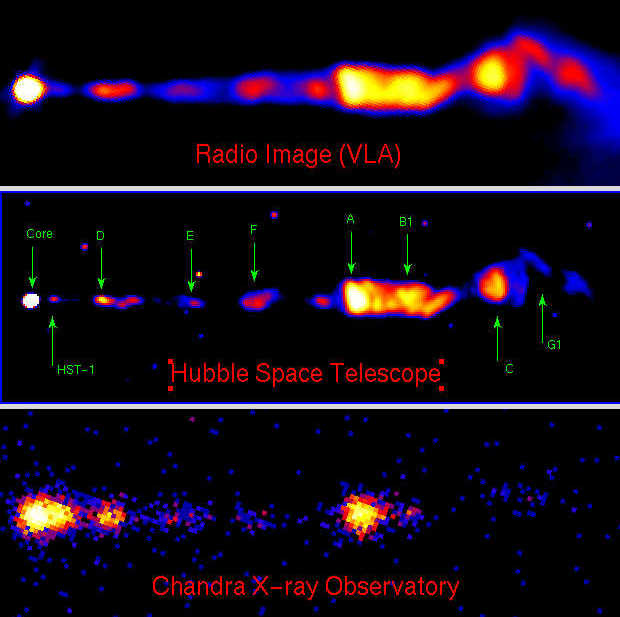
But note that while the distance between two charge separation regions may be quite small, the overall size of each each region may be enormous. For example, the jet emerging from the galaxy M87, has been estimated to be 5400 light-years long.
Plasma holes
Spontaneous quasi-neutrality breaking has been observed in a rotating plasma (plasma hole). Tanaka and Yoshimura write:
- “plasmas are electrically neutral and breaking of this condition is rarely found in laboratories and space. An example of charge-neutrality breaking is sheath formation in front of a current-extracting electrode immersed into the plasma, and another example is a double layer. For both cases, the layer of quasi-neutrality breaking is very thin and is typically of the order of 101 times the Debye length. [..]
- “Recently, a singular vortex was found in a magnetized cylindrical plasma [1][7] and revealed that the spontaneous breaking of quasi-neutrality condition occurs in the bulk plasma. The vortex is called plasma hole [2][8] [..] The fast rotation suggests that there exists a strong radial electric field to drive the vortical motion by E × B drift, [..]
- “.. [regarding] the degree of nonneutrality in the presence of a plasma hole .. there exists a sharp peak in the center (hole region), and its value reaches to the order of 10−3. In the peripheral region, however, the degree of nonneutrality is δn/n ≈ 10−6 as is expected. The difference in δn/n is three orders of magnitude higher than the peripheral, and therefore, we can conclude that quasi-neutrality breaking occurs in the center of the plasma hole.”[9]
History
The word “Quasi-neutrality” appears to have been first used in a chemistry context in 1907,[10]. In a plasma context, the word appears to have been first used by Irving Langmuir and Lewi Tonks, in 1929.[11]
Notes
- ↑ H. D. Curtis, Lick Obs. Publ., vol. 13, p. 11, 1918.
- ↑ Anthony L. Peratt, “Evolution of the Plasma Universe: I. Double Radio Galaxies, Quasars, and Extragalactic Jets“, IEEE Transactions on Plasma Science Vol. PS-14 No.6 (Dec 1986) PaperFULL TEXT PDF PEER REVIEWED
- ↑ “M87’s Energetic Jet”, NASA Astronomy Picture of the Day, 11 Dec 2004
- ↑ Chapter 19: “The Particle Kinetics of Plasma“, Course notes, Applications of Classical Physics
- ↑ Mozer, F. S. et al, “Observations of paired electrostatic shocks in the polar magnetosphere“, Physical Review Letters, vol. 38, Feb. 7, 1977, p. 292-295.
- ↑ Block, L. P., “A double layer review“, FULL TEXT Astrophysics and Space Science, vol. 55, no. 1, May 1978, p. 59-83. PEER REVIEWED
- ↑ K. Nagaoka, A. Okamoto, S. Yoshimura, M. Kono, and M. Y. Tanaka,
“Spontaneous formation of a plasma hole in a rotating magnetized plasma: A giant Burgers vortex in a compressible fluid,” Phys. Rev. Lett., vol. 89, no. 7, pp. 075 001.1–075 001.4, 2002 - ↑ M. Y. Tanaka, K. Nagaoka, A. Okamoto, S. Yoshimura, and M. Kono, “Plasma hole“, IEEE Transactions on Plasma Science, vol. 33, no. 2, pp. 454–455, Apr. 2005.
- ↑ Tanaka, M.Y. Yoshimura, S., “Quasi-Neutrality Breaking in a Rotating Plasma“, IEEE Transactions on Plasma Science, Aug. 2008, Volume: 36, Issue: 4, Part 1 On page(s): 1224-1225
- ↑ According to search result by Google Books
- ↑ Irving Langmuir and Lewi Tonks, “General Theory of the Plasma of an Arc“, Phys. Rev. 34, 876 – 922 (1929), Issue 6, September 1929. PEER REVIEWED