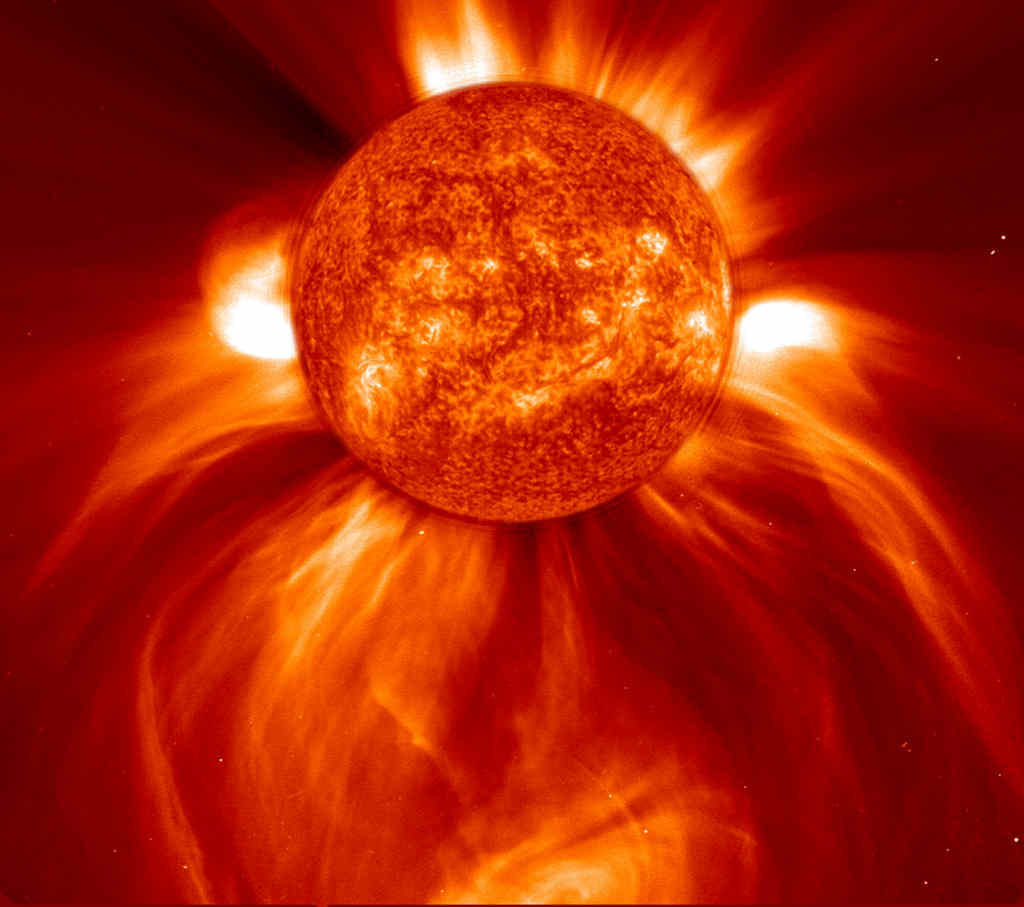
Electromagnetic forces occur when an electromagnetic field interacts with electrically charged particles, such as those that make up a plasma (ie. electrons, protons and other ions). It include the electric force, which produces electric fields between charged forces, and the magnetic force, which manifests itself as magnetic fields wherever there are moving charges.
Plasmas interact strongly with electromagnetic forces, resulting in complexity in structure and motion that far exceeds that found in gases, liquids, and solids. This is exemplified by solar flares and the solar wind, which overcome the Sun’s magnetic field, accelerates away, and out into interplanetary space.
The formula that describe the behavior of electric and magnetic fields, and their interactions with matter, were derived by Oliver Heaviside (1831-1925), but are now called Maxwell’s equations after James Clerk Maxwell (1831–1879).
Contents
Electromagnetic force vs gravitational force comparison
Between charged particles
The electromagnetic force can be compared to the gravitation force, by considering these forces between two charged particles.
Electrostatic force |
Gravitational force |
|
| Appropriate law | Coulombs law | Newton’s law of universal gravitation |
| Appropriate equation | :\(F_e = k_e{q_1q_2\over r^2}\) | \(F_g = G \frac{m_1 m_2}{r^2}\ \) |
| Labels |
|
|
| Values |
|
|
| Units |
|
|
A comparison of the magnitude of the two forces is given by:
- \({F_e \over F_g} = {k_e{q_1 q_2\over r^2} \over G \frac{m_1 m_2}{r^2} } = {k_e \over G} {{q_1 q_2} \over {m_1 m_2} }\)
Between two electrons, a comparison of the electrostatic force compared to the gravitational force, is given by:
- \({F_e \over F_g} = {k_e \over G} {{q_e q_e} \over {m_e m_e} } = {8.988 \times 10^9 \over 6.674 \times 10^{-11} } {{(-1.602 \times 10^{-19})(-1.602 \times 10^{-19})} \over {(9.109 \times 10^{-31})(9.109 \times 10^{-31})} } = {2.307 \times 10^{-28} \over 5.538 \times 10^{-71} } = \boldsymbol{4 \times 10^{42} }\)
Between an electron and a proton, a comparison forces, is given by:
- \({F_e \over F_g} = {k_e \over G} {{q_e q_p} \over {m_e m_p} } = {8.988 \times 10^9 \over 6.674 \times 10^{-11} } {{(-1.602 \times 10^{-19})(1.602 \times 10^{-19})} \over {(9.109 \times 10^{-31})(1.673 \times 10^{-27})} } = {2.307 \times 10^{-28} \over 1.017 \times 10^{-67} } = \boldsymbol{2 \times 10^{39} }\)
Between two protons, a comparison of the forces, is given by:
- \({F_e \over F_g} = {k_e \over G} {{q_p q_p} \over {m_p m_p} } = {8.988 \times 10^9 \over 6.674 \times 10^{-11} } {{(1.602 \times 10^{-19})(1.602 \times 10^{-19})} \over {(1.673 \times 10^{-27})( 1.673 \times 10^{-27})} } = {2.307 \times 10^{-28} \over 1.868 \times 10^{-64} } = \boldsymbol{1 \times 10^{36} }\)
In a partially ionized plasma
Even in a partially ionized plasma, the force on a charged particle by a magnetic field is significant:
- “The basic reason why electromagnetic phenomena are so important in cosmical physics is that there exist celestial magnetic fields which affect the motion of charged particles in space. Under certain conditions electromagnetic forces are much stronger than gravitation. In order to illustrate this, let us suppose that a particle moves at the earth’s solar distance RE ((the position vector being RE) with the earth’s orbital velocity v. If the particle is a neutral hydrogen atom, it is acted upon only by the solar gravitation (the effect of a magnetic field upon a possible atomic magnetic moment being negligible). If M is the solar and m, the atomic mass, and γ is the constant of gravitation, this force is f = –γMm RE/RE3. If the atom becomes singly ionized, the ion as well as the electron (charge e = ± 4.8 x 10⁻¹⁰ e.s.u.) is subject to the force fm = e(v/c) x B from an interplanetary magnetic field which near the earth’s orbit is B. The strength of the interplanetary magnetic field is of the order of 10-4 gauss, which gives fm/f ≈ 107. This illustrates the enormous importance of interplanetary and interstellar magnetic fields, compared to gravitation, as long as the matter is ionized.[1]
Even weakly ionized plasma reacts strongly to electromagnefic fields.
Which force dominates?
A. Ferrari notes:
- “Stars are dominated by gravitation, but their surface activity is due to electromagnetic forces. Similarly, the interstellar and intergalactic matter are shaped by plasma forces; and galaxies also show plasma collective behavior where long-range forces are gravitational forces acting on a gas of stars. Active stars (pulsars, X-ray binaries, transient sources, etc) and active galactic nuclei appear to be dominated by plasma effects”.[2]
Alfvén writes:
- “Even at the distance of Pluto a proton moving with the same velocity as Pluto is much more affected (250 times) by the magnetic force than by solar gravitation!”[3]
Electromagnetic field
The electromagnetic field is a physical field that is produced by electrically charged objects and which affects the behaviour of charged objects in the vicinity of the field. The electromagnetic field extends indefinitely throughout space and describes the electromagnetic interaction, one of the four fundamental forces of nature (including gravitation, the weak interaction, and the strong interaction). The field can be viewed as the combination of an electric field and a magnetic field. The electric field is produced by stationary charges, and the magnetic field by moving charges (currents); these two are often described as the sources of the field. The way in which charges and currents interact with the electromagnetic field is described by Maxwell’s equations and the Lorentz Force Law.
The behavior of the electromagnetic field can be resolved into four different parts of a loop: (1) the electric and magnetic fields are generated by electric charges, (2) the electric and magnetic fields interact only with each other, (3) the electric and magnetic fields produce forces on electric charges, (4) the electric charges move in space.
A particle at rest feels only the force due to the electric field.
Acceleration
- “Only electric fields can accelerate charged particles. Gravity is too weak by several orders of magnitude, and collisions are much to rare”[4]
A magnetic field produces a force that is always perpendicular to path that a charge follows. Since the magnetic force always acts at right angles to the motion of a charge, it can only turn the charge, it cannot do work on the charge.
A changing magnetic field also produces an electric field (Faraday’s Law).
Footnotes
- ↑ Hannes Alfvén and Carl-Gunne Fälthammar, Cosmic Electrodynamics (1963) “Chapter 1 General Survey”, Oxford University Press. ACADEMIC BOOK
- ↑ B. Coppi, Attilio Ferrari, Elio Sindoni, Plasmas in the Universe, (2000) in “Astrophysical Plasmas”, ISBN 1586030736, (page 1)
- ↑ Alfvén, Hannes, “On the cosmogony of the solar system”, Stockholms Observatoriums Annaler, vol. 14, No.2 Page 5 FULL TEXT
- ↑ Block, L. P., “Acceleration of auroral particles by magnetic-field aligned electric fields” FULL TEXT (1988) Astrophysics and Space Science (ISSN 0004-640X), vol. 144, no. 1-2, May 1988, p. 135-147. PEER REVIEWED